Budget prioritizes defence, but Canadians may not support huge long-term investment, experts say

While Canadians appear to support the significant investment in defence the Canadian government is planning, one security expert doubts this support will continue in the longer term.
The 2025 federal budget, which narrowly passed a confidence motion, will “rebuild, rearm, and reinvest in the Canadian Armed Forces (CAF), ensuring our military has the personnel, equipment, training, and infrastructure it needs to protect Canadians and lead abroad,” according to a summary document.
Carleton University Prof. Eric Van Rythoven, who researches international relations and the politics of security, says the shift in spending is radical.
“In the area of defence, this budget is unambiguously transformative,” he said. “It reams huge sums of money into defence spending, not just on the Canadian Forces, the Department of National Defence, but also investing in Canada’s defence industry and … new defence technologies.”
The federal government says Budget 2025’s defence spending is part of a broader strategy that balances security needs with fiscal responsibility and economic development. Much of the announced spending will support modernization projects stretching over a decade, meaning the full economic impact will be gradual.
The budget earmarks $81.8 billion over five years for defence, including $19 billion to repair and sustain Canadian Armed Forces capabilities, $10.9 billion for digital and cyber infrastructure and $17.9 billion to expand military capabilities in vehicles, counter-drone systems and long-range strike technology. A further $6.6 billion is intended to strengthen Canada’s defence industry and domestic supply chains.
The spending will help get Canada closer to a new spending target of five per cent of GDP that NATO leaders have agreed. Canada pledged to reach two percent of GDP, but had averaged well below that for many years.
“There’s been a realization that there’s been underspending for years, and so the military has all kinds of capabilities it needs,” said Stephen Saideman, director of the Canadian Defence and Security Network, and Carleton University’s Paterson Chair in International Affairs. He singled out the need to increase pay and fix outdated infrastructure.
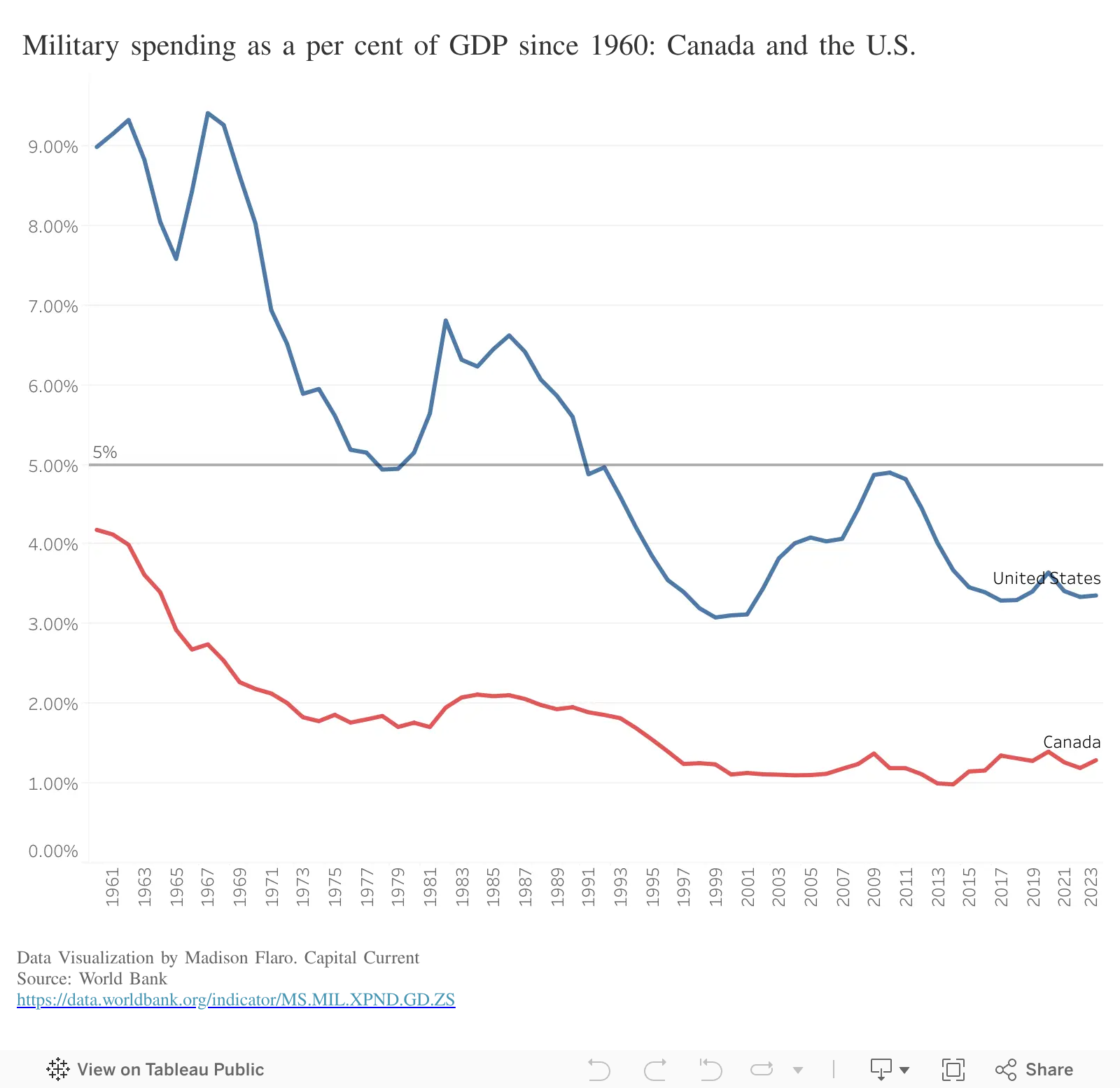
What is motivating the increase? NATO
In 2014, the North Atlantic Treaty Organization made the two per cent commitment to be reached by 2024.
Saideman noted that this commitment was in reaction to the Russian seizure of Crimea, a region of Ukraine. In 2022, when Russia invaded the rest of Ukraine, the war revealed gaps in capabilities for allies like Canada.
“The war itself revealed what NATO was lacking, the NATO countries were lacking,” said Saideman.
According to Van Rythoven, the 2022 Russian invasion of Ukraine has motivated countries such as Poland to increase spending on defence beyond two per cent.
Canada had another motivation: the election of U.S. President Donald Trump. Before his second term, Van Rythoven said that “there was no party in Canadian politics that was interested in spending two per cent of GDP on defence because there were other priorities.”
Now, Prime Minister Mark Carney is set on meeting the two per cent spending target this year, a timeline jump since former PM Justin Trudeau’s promise to reach that goal in 2032.

At the June 2025 summit in The Hague, NATO leaders agreed to the a new, higher goal of five per cent of GDP on defence spending by 2035.
The five per cent target includes of 3.5 per cent of GDP in defence spending, which includes personnel and equipment, and 1.5 per cent in security-related expenditure, allocating money to protect infrastructure, ensuring civil preparedness and enhancing resilience.
The open-ended nature of the new goal, which Van Rythoven calls a kind of “accounting trick,” allows NATO members to count non-military spending as defence spending. In a June 25 press release, Carney indicated this spending would go toward new airports, ports, telecommunication, and emergency preparedness systems.
Public opinion research suggests that Canadians are broadly supportive of the increase in defence spending. In one poll from Abacus Data, 62 per cent of respondents supported an increase in spending, with only nine per cent opposed. A poll from Nanos found similar support, but far fewer respondents favoured an increase in spending to five per cent of GDP, compared with two per cent. And an Angus Reid survey found nearly half of Canadians thought the five per cent target was too high and would take away from other priorities.
However, Van Rythoven believes support for increased defence spending now is only because of the “fragile coalition of public support” stemming from Canadian anxiety about the U.S. relationship. The tensions that underpin defence spending support now may not apply to the 2035 five per cent target.
“I cannot see a future where Canadians will tolerate that kind of spending on defence at the expense of other priorities,” Van Rythoven said.
link