Investors brace for volatility amid geopolitical risk

Markets are experiencing renewed volatility as geopolitical tensions resurface, including U.S. President Donald Trump’s renewed claims on Greenland. Investors are weighing uncertainty against still-solid economic and earnings fundamentals as they position for the year ahead.
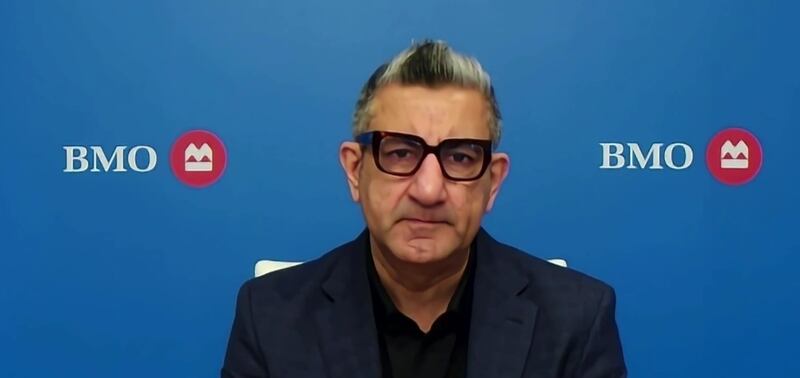
BNN Bloomberg spoke with Sadiq Adatia, chief investment officer at BMO Asset Management, about navigating geopolitical risk, portfolio hedging strategies and why staying invested may be preferable to trying to time short-term volatility.
Key Takeaways
- Geopolitical tensions tend to be disruptive rather than destructive, often increasing volatility without fundamentally altering long-term investment trends.
- Strong earnings growth and resilient consumer spending continue to support equities despite short-term market unease.
- Hedging strategies such as gold and options can help manage downside risk while allowing investors to remain invested.
- U.S. equities remain favoured over international markets due to stronger economic momentum and earnings visibility.
- Bonds still play an important diversification role, though higher correlations with equities have increased the appeal of alternative hedges.
Read the full transcript below:
ANDREW: U.S. President Trump is showing no signs of backing away from his claims on Greenland. Let’s get perspective from Sadiq Adatia, chief investment officer at BMO Asset Management. Sadiq, thanks very much for joining us. A guest told us yesterday that this kind of Trump aggression, this kind of geopolitical tension, tends to be disruptive to markets but not destructive. What do you think? Obviously, equity investors are concerned here.
SADIQ: Yeah, I think this is something you see constantly. Geopolitical risks or tensions in other parts of the world cause markets to be a little uneasy and a little nervous. You see volatility pick up, and consumers and investors get more cautious. That’s kind of what we’re seeing at the moment. It’s the uncertainty factor that has people on edge.
I think as things play out, it’s never as bad as it initially seems. Markets start to embrace it, price it in and move on. We saw that last year, and we’ve seen that multiple times with the Russia-Ukraine situation as well. These are the types of things that catch people’s attention, but in the grand scheme of things, not really something you want to react to very quickly right now. If information gets worse down the road, that’s a different story. But for now, it’s a situation where you want to keep it in mind, but not adjust your portfolio significantly.
ANDREW: Let’s have a look at a one-year chart for the S&P 500. I know it almost comes down to a philosophical question here, Sadiq — is it even possible to time the market on these things? But there might be a case to be made to lighten up on equities until there’s some clarity on Greenland.
SADIQ: Sure. Our view coming into the year was being bullish on equities, including the U.S., and it really comes back to fundamentals. When you look at fundamentals, earnings have been relatively good and are even broadening out, which is great. We’re still seeing consumer spending. Sure, maybe it’s pulling back a little, but we’ve also seen very strong returns.
I think that’s the part people are getting nervous about — we’ve had so many good years of positive returns that there must be a pullback. I don’t think that’s necessarily true. But when you get things like what we’re seeing more recently with Greenland and other issues, that can push people to unwind risk or take some equity exposure off the table.
A better way to manage that is to find hedges, things like gold or buying options to protect the downside. That way you stay invested while hedging some of the risk in case things do get worse.
ANDREW: Possibly buy put options, for example?
SADIQ: That’s correct. You can buy them over various periods of time, and your cost is just the premium. You don’t give up the upside, and you’re protected at a level of risk you’re comfortable with. If you’re worried about more than a five per cent drop, you can protect beyond that level. You can structure it in a way that makes sense for you. That’s a better approach than taking equities fully off the table and missing potential upside, because then you’re trying to time the market.
ANDREW: Broadly for 2026, you’re saying overweight U.S. equities but remain underweight Europe, Asia and the Far East. So you’re sticking with a relatively bullish call on U.S. stocks?
SADIQ: Yeah. We just did our 2026 BMO GAM outlook call, and one of the themes across the teams was being underweight international markets. The key reason is that international markets had a strong run last year, helped in part by defence spending tied to what was going on in the U.S. administration.
What’s happening with Greenland highlights that there’s still pressure on Europe. I don’t think the region has reached a point where the economy is exceptionally strong across all countries. There’s some optimism, but you still want to see the economy move in the right direction before going overweight.
We like the U.S. a lot more. Earnings remain relatively strong, it’s still the strongest economy out there, and consumers are still spending. When comparing U.S. and international markets, we continue to tilt toward the U.S.
ANDREW: Bonds — presumably you would tell me every investor should have some exposure. It varies, but should everyone, as a general rule, have at least some bonds?
SADIQ: It depends on your time horizon and risk tolerance, but to be prudent and well diversified, you do need bonds. In periods like what we’re seeing now, bonds tend to do better than equities when volatility and nervousness rise.
We have seen bonds become a bit more correlated with equities, which is why we’ve favoured gold more recently. But bonds still play an important role because of the diversification benefits they typically provide.
ANDREW: What about duration? Would you go longer-term bonds, which can be more volatile but tend to do well if inflation expectations are modest?
SADIQ: If you think about where we are now, we’re probably expecting maybe two U.S. rate cuts. That means the short end of the curve comes down, but the long end may not change dramatically. You want to position carefully, knowing rates may come down, but perhaps not as much as some expect unless there’s another flare-up somewhere.
I think it makes sense to spread your bond exposure and add some higher-yielding securities — not necessarily high yield, but investment-grade credit, for example — to pick up extra yield. That provides some added safety within the bond portfolio, especially if yields decline over time.
ANDREW: Sadiq, thank you very much indeed.
SADIQ: Thanks for having me.
ANDREW: Sadiq Adatia, chief investment officer at BMO Asset Management.
—
This BNN Bloomberg summary and transcript of the Jan. 20, 2026 interview with Sadiq Adatia are published with the assistance of AI. Original research, interview questions and added context was created by BNN Bloomberg journalists. An editor also reviewed this material before it was published to ensure its accuracy and adherence with BNN Bloomberg editorial policies and standards.
link